


Hair Dye
CrazyLabs LTD
I spent time with Hair Dye, a colorful role-playing game from CrazyLabs LTD that turns salon styling into a series of quick, visual challenges. The basic idea is easy to understand: choose a hairstyle, mix colors, apply dye, and see how the finished look comes together. It is free to play, rated for Everyone, and available for devices running Android 7.0 or later, which makes it approachable for many casual players.
What interested me most was not simply whether the hair designs looked fun. I wanted to see how comfortably the game worked for different players, including people who prefer simple navigation, have limited dexterity, become tired by fast interactions, or play in distracting everyday situations. My overall impression is positive, but with an important qualification: this is a visually led game, so its accessibility depends heavily on how comfortably a player can follow color changes, distinguish details, and complete touch gestures.
A colorful salon game that is easy to enter
The opening experience is pleasantly direct. Hair Dye does not ask me to learn a complicated role-playing system before I can start styling. The salon theme gives each activity an obvious purpose, and the visual presentation does much of the explaining. I can generally understand what I am meant to do by looking at the model, the available colors, and the current stage of the makeover.
That simplicity is one of the game's strongest qualities. Someone who normally avoids games with inventories, long tutorials, or layered menus can pick it up and begin experimenting almost immediately. The game feels designed for short sessions rather than extended planning. I can play for a few minutes while waiting somewhere, complete a styling sequence, and put the phone down without needing to remember a complicated objective.
The role-playing label is quite light in practice. This is not a story-heavy adventure with character statistics or a deep salon-management simulation. Its appeal comes from the fantasy of changing a character's appearance and making visual choices. Players looking for a relaxed makeover experience will understand the appeal quickly, while anyone expecting detailed character development may find the category description broader than the actual depth.
Related News

Why WhatsApp Messenger Still Makes Everyday Communication Feel Easy

Jurassic World: The Game Is the Better Dino Tycoon for Strategic Players

Threads in Real Life: Who Should Join, Lurk, or Leave

How SHEIN Turned Shopping Into an Endless Content Feed

How to Make Fortnite Feel Smarter on Mobile

Should You Switch to Microsoft Outlook on Mobile?
The game has attracted a large audience, with more than one hundred million installs and an average rating of 4.4 from roughly three hundred forty-one thousand ratings. Those figures suggest that the quick, colorful format has wide appeal, although popularity alone does not guarantee that the controls or presentation will suit every player.
Readability and navigation in ordinary play
Navigation is one of the more comfortable parts of the experience. The game presents actions through large visual areas rather than dense text menus, so I rarely need to stop and decode a complicated interface. The salon setting also helps: color selection, hair application, and finishing actions feel connected to what I see on screen instead of being hidden behind abstract labels.
This matters for players who find text-heavy games tiring. The main loop communicates through images and immediate feedback, making it possible to understand the next step without reading long instructions. A child who is still developing reading confidence may be able to follow the activity through observation and trial. An adult who simply wants a low-effort distraction can also get moving quickly.
Gallery
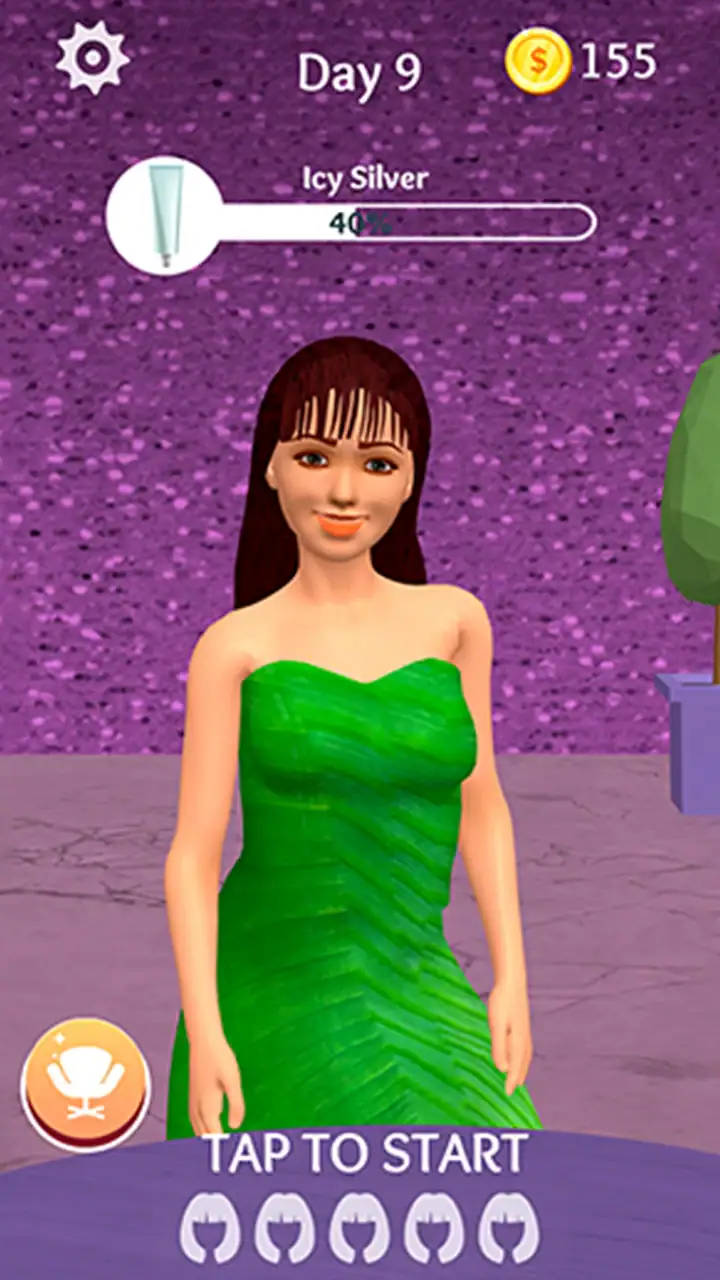
There is a trade-off, though. A visual interface is only clear when the visual cues are clear to the player. If someone has difficulty distinguishing similar shades, small details in the hair, or changes in the model's appearance, the same simplicity can become ambiguous. The game does not turn its color-based tasks into a text-described process, so its readability is strongest for players who can comfortably interpret the screen.
I also found that the uncluttered structure works best when the phone is held close and the display is reasonably clear. On a small screen, the hair itself can occupy a limited area, and details that look obvious at first may require a closer look. Increasing the device's general text size may not improve every game element, because the most important information is presented as artwork and interactive graphics rather than ordinary system text.
For a smoother start, I would recommend playing the first few styling rounds in a calm place instead of beginning during a rushed commute. That gives you time to notice which areas respond to taps or swipes and whether the color choices are visually distinct enough for you. Once the pattern feels familiar, the game becomes much easier to use casually.
Motor demands and sensory comfort
The main physical demand comes from touch interaction. Hair coloring is naturally suited to tapping and dragging, but the experience still requires a certain level of hand control. Players with limited dexterity, tremors, joint pain, or difficulty maintaining a steady finger may find precise styling actions less comfortable than simple menu selection.
One useful way to approach the game is to avoid treating every movement as a test of perfection. I found it more manageable when I slowed down, used one finger consistently, and held the phone securely rather than trying to play one-handed while walking or carrying something. A stable grip can make a noticeable difference in a game where the important target is a visual section of hair rather than a large button.
This also explains why Hair Dye may be more suitable for some motor abilities than others. A player who can tap accurately but struggles with sustained dragging may enjoy the color-selection portions more than stages requiring careful application. Someone who has difficulty with both small taps and continuous gestures may need assistance from another person or may prefer a game built around larger, simpler controls.
Sensory comfort is another consideration. The bright salon presentation is central to the game's identity, but players sensitive to strong colors, rapid visual changes, or busy animations may find longer sessions tiring. I would not describe the game as visually quiet. Its appeal comes from watching a makeover take shape, so people who prefer muted interfaces or minimal stimulation may enjoy it only in short bursts.
Sound can also affect the experience, especially in shared spaces or when playing late at night. I often keep the device muted when I want a discreet session. The game remains understandable through its visual actions, so silent play is a practical option for situations such as a waiting room, a school break, or a quiet office. That makes it more flexible than a game whose progress depends on spoken instructions or constant audio cues.
For children, the Everyone rating makes the concept broadly approachable, but the touch requirements still matter. A younger player may understand the salon fantasy while needing help with precise gestures. That is not a flaw in the theme; it is simply a reminder that an age rating describes general content suitability, not the physical ease of every interaction.
How it works in different everyday situations
Hair Dye fits particularly well into short, interrupted sessions. Imagine waiting for an appointment with only a few minutes available. I can open the game, work through a color change, and stop when my name is called. The visual loop is easy to resume because the current hairstyle shows what I am doing. I do not need to reconstruct a complicated plot or remember a long chain of instructions.
It is also a reasonable choice for a relaxed shared activity. One person can suggest a color while another handles the phone, which reduces the pressure on a player who finds precise touch movements difficult. A parent and child could discuss whether a style should be bold or subtle, turning the game into a small creative conversation rather than a solitary challenge.
However, the same design is less suitable when the player needs reliable access without close visual attention. It is not the kind of game I would choose while cooking, walking, or traveling on a bumpy vehicle. The hair and color areas require attention, and divided focus can lead to inaccurate touches. A player who wants something that can be enjoyed mainly through audio, large text, or automatic progress should look elsewhere.
The game's free price lowers the barrier to trying it. I can test the basic experience without making a purchase decision first, which is useful for families or for anyone unsure whether a color-focused game will hold their interest. Free access does not automatically mean a completely frictionless experience, though. In casual mobile games, interruptions and optional commercial elements can affect the rhythm, so players who dislike breaks may need patience.
On the technical side, the current version is 1.9.5.3, and the listed minimum operating system is Android 7.0. That gives the game a relatively broad device range, but practical comfort still depends on the phone itself. A device with a small display, weak touch response, or limited performance can make visual styling less pleasant even when the operating system is supported.
Where the inclusive experience still has limits
The biggest remaining barrier is the game's dependence on color and visual detail. A player with color-vision differences may not experience the same clarity as someone who can easily separate every shade. When the point of a stage is to mix or apply colors, this is not a minor decorative issue; it affects the central activity. I would be cautious about recommending the game as a primary choice for someone who needs non-color alternatives or strong text-based guidance.
There is also a difference between seeing an image and interpreting an interactive target. Even if the screen is visible, it may not always be obvious which part of the hairstyle accepts a gesture or whether a particular movement has been completed correctly. Players with visual processing difficulties may need extra time, a larger display, or another person to explain what the game is asking them to do.
Motor accessibility is similarly mixed. The game benefits from being touch-first and visually immediate, but it does not remove the need for controlled hand movement. External accessibility tools on a phone may help with general device use, yet they cannot necessarily replace a precise in-game drag or make every hair section easier to target. That is why I see the game as accessible in its simplicity, but not universally accessible in its interaction design.
Another limitation is the lack of depth for players who want a more structured role-playing experience. The makeover loop is enjoyable because it is quick, but it can feel repetitive if you want long-term character development, strategic choices, or a detailed salon economy. A conventional role-playing game would offer more narrative and progression, while a dedicated creative design app might offer more control over the final look. Hair Dye sits between those alternatives: more playful than a static editor, but less involved than a full simulation.
Players who dislike visual trial and error may also become frustrated. The game encourages experimentation, which is fun when a surprising color combination works. It is less satisfying for someone who wants exact instructions, predictable results, or a detailed explanation of why a particular choice succeeds. I enjoyed the freedom, but I would not call it a precision hair-design tool.
Who will enjoy it, and who should skip it
I would recommend Hair Dye to casual players who like makeover themes, bright visual feedback, and short activities that can be understood without a long tutorial. It is especially appealing if you enjoy seeing a character change quickly and prefer interaction over reading. Families may also find it approachable because the concept is easy to explain and the content is suitable for Everyone.
It is a good fit for someone who wants a low-commitment game rather than a demanding role-playing adventure. The free entry point makes experimentation simple, and the broad Android compatibility means many players can at least try it on an existing device. I also think it works well for creative-minded players who enjoy making a choice and immediately seeing its effect, even if the available control is not as detailed as in a professional design app.
I would suggest skipping it if your priority is deep storytelling, complex progression, or a salon simulation with business management. It is also not my first recommendation for players who need audio-led interaction, strong non-color alternatives, or extremely forgiving controls. In those cases, a text-rich role-playing game, a slower creative app, or a game built around larger and more adjustable input may be a better match.
Before installing, I would ask myself three practical questions. Can I comfortably distinguish the colors and hair details on my phone? Can I make controlled taps or drags without pain or excessive fatigue? Do I want a quick visual activity rather than a substantial role-playing system? If the answer to these questions is yes, the game has a good chance of fitting naturally into your routine.
My inclusive verdict after playing
Hair Dye succeeds because it makes its central fantasy immediately understandable. I do not need to study a manual to start changing a hairstyle, and the short-session format respects the way many people use mobile games. Its visual navigation is friendly, its content is broadly suitable, and its free price makes it easy to test without commitment.
At the same time, I would not describe it as accessible for every ability or every context. Its strongest features are also its main limitations: color is the focus, visual feedback carries much of the instruction, and touch gestures require a degree of precision. Players with color-vision differences, visual processing challenges, or limited hand control may encounter barriers that are not obvious from the simple salon concept.
My final recommendation is therefore specific rather than universal. If you want a cheerful, easy-to-start makeover game for brief sessions, I think it is worth trying. Play with the phone supported, use a comfortable grip, mute it when you need a quiet experience, and give yourself time to learn the touch areas instead of rushing through them. If you need adjustable controls, non-visual guidance, or deeper role-playing mechanics, choose another style of game.
With over three hundred thousand ratings and more than one hundred million installs, Hair Dye clearly connects with a very large casual audience. My own view is that its appeal is genuine, but best understood as a colorful touch-based salon toy with light role-playing elements. Its inclusive strength is simplicity; its inclusive weakness is reliance on visual color work and precise gestures. That balance makes it enjoyable for the right player, but important to consider before recommending it to everyone.
FAQs for Hair Dye
What features does the Hair Dye app offer?
The Hair Dye app provides a virtual platform to experiment with various hair colors using augmented reality. Users can upload a photo or use the live camera feature to see how different shades look in real-time. The app includes a wide range of colors, from natural hues to vibrant, bold options. Additionally, it offers customization tools to adjust brightness and saturation.
Is the Hair Dye app user-friendly for beginners?
Yes, the Hair Dye app is designed with an intuitive interface that is easy for beginners to navigate. The step-by-step guidance helps users upload photos and apply colors seamlessly. The app also includes tutorials and tips on choosing the best shades based on skin tone and current hair color, making it accessible for users with no prior experience in digital hair coloring.
Does the Hair Dye app require a subscription or one-time purchase?
The Hair Dye app is free to download with basic features available at no cost. However, it offers in-app purchases for premium features, such as access to exclusive color palettes and advanced editing tools. Users can choose either a monthly subscription or a one-time purchase option to unlock these additional features.
Is the Hair Dye app available for both Android and iOS devices?
Yes, the Hair Dye app is available for download on both Android and iOS platforms. The app is optimized for a wide range of devices, ensuring a smooth user experience regardless of the operating system. Users can find the app on the Google Play Store for Android devices and the Apple App Store for iOS devices.
How accurate are the hair color simulations in the Hair Dye app?
The Hair Dye app uses advanced augmented reality technology to provide realistic hair color simulations. While the app strives for high accuracy, factors such as lighting, original hair color, and photo quality can affect the outcome. Users are encouraged to test under different conditions and consult a professional for a more precise match if needed.
Pros
- User-friendly interface for easy navigation.
- Wide variety of color options available.
- Realistic color preview on your photo.
- Includes tutorials for beginners.
- No ads interrupting the experience.
Cons
- Limited free features without subscription.
- Occasional app crashes on older devices.
- Requires high-quality photo for best results.
- Some colors appear slightly unrealistic.
- In-app purchases can be pricey.


